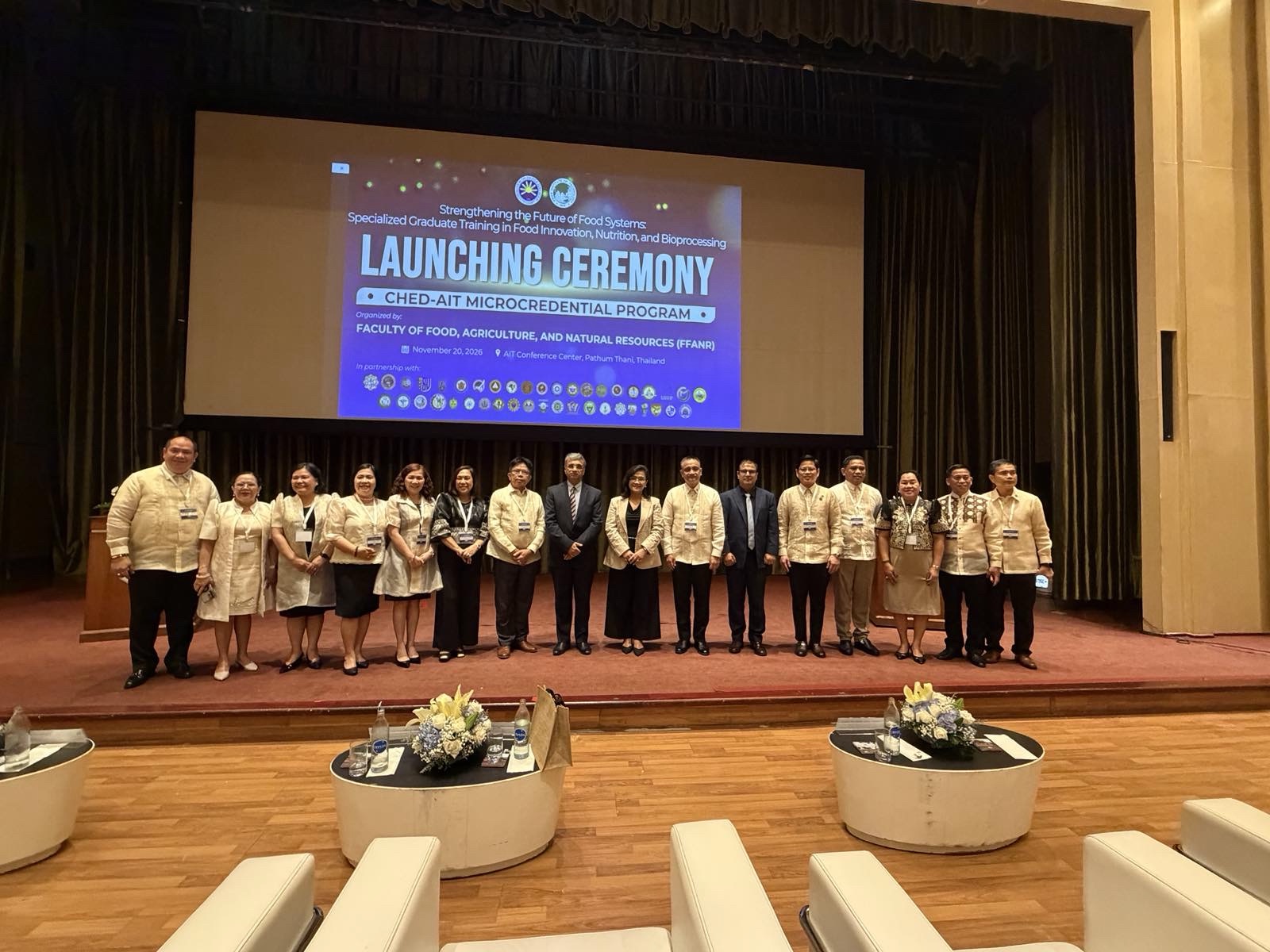
In its quest to further advance faculty upskilling, Tarlac State University joined the Commission on Higher Education-Asian Institute of Technology (CHED-AIT) Microcredential Program launch ceremony on November 20, 2026, in Pathum Thani, Thailand.
Titled "Strengthening the Future of Food Systems: Specialized Graduate Training in Food Innovation, Nutrition, and Bioprocessing," the microcredential program is a part of CHED’s iPath Pro (Industry-Based Microcredential Pathways Toward Graduate Programs in Probiotics and Functional Foods for Sustainable Health and Nutrition) program under the CHED HUSAY Program (Higher Education Upskilling and Study for Advancement of Staff and Faculty).
University President Dr. Jasper Jay N. Mendoza thanked AIT for opening its classrooms and laboratories to Filipino educators, and Chairperson Agrupis for leading this initiative and opening it to state universities and colleges across the Philippines. The HUSAY Program, he said in an interview with the Office of Public Affairs, "tells our faculty that the country is willing to invest in them."
The university is moving to expand its existing partnership with AIT and has committed to helping answer Chairperson Agrupis's call to increase the number of faculty members with doctoral degrees, which now stands at about 19 percent across the country's higher education institutions.
Pres. Mendoza affirmed the university's commitment to accepting the call and taking on the challenge by Chairperson Agrupis. This supports Dalan ng Pagpapaunlad and Dalan ng Karunungan under TSU's DALAN Framework, which underscores the importance of strengthening institutional capacity and developing human resources to build a more responsive, capable, and future-ready university.
He pointed to the newly launched program as the model. "Our faculty do not have to choose between serving their students and growing as scholars," he added.
The program trains faculty members from Philippine higher education institutions through stackable micro-credentials: three certificates, each worth 9 credits, that together lead to an AIT diploma and can be credited toward a master's or doctoral degree.
The university also congratulates Dr. Leah T. Matias, who earned a place in the program and now represents TSU as a faculty scholar at AIT. She is completing the face-to-face phase of the first certificate from November 8 to December 4, 2026.
"What she learns will come home to that work," Pres. Mendoza said, referring to TSU's services for local food enterprises.
The CHED Chairperson also asked universities with industrial technology programs to look at semiconductors.
Pres. Mendoza noted that TSU has a College of Industrial Technology, a program in electronics engineering, and an advanced manufacturing training hub. He said the university will review its foreign university partnerships and study how to build stackable micro-credentials in semiconductor technology, following the iPath-Pro model that CHED developed with AIT and in which TSU already takes part.
Now 120 years old, TSU serves more than 27,000 students through 46 undergraduate and 23 graduate programs.
Pres. Mendoza told the gathering that many of its strengths are in fields AIT is known for:
- Food technology and nutrition. The Center for Food Technology and Research holds an FDA license to operate and assists local food enterprises with product development and food safety.
- Engineering and industrial technology. TSU offers civil, electrical, electronics, and mechanical engineering, with master's programs in civil and electrical engineering.
- Energy and environment. A Center for Solar Technology and Innovation is being built, and the College of Science offers chemistry and environmental science.
- Computing, management, and governance. Programs in computer studies run up to the graduate level, alongside doctorates in business administration and public administration.
TSU and AIT already work together through CHED's HUSAY and iPath-Pro programs. Pres. Mendoza said the launch opens the door to sending more TSU faculty members abroad as scholars, and proposed three areas for wider collaboration:
- A pathway for TSU faculty from micro-credentials to master's and doctoral degrees at AIT.
- A stackable micro-credential in semiconductor technology, developed with a foreign partner university.
- Joint research and exchange in food innovation, renewable energy, and the environment.